
Lahore Travel Guide: History, Food & Culture
Lahore is Punjab's capital and Pakistan's second-largest city, home to about 13 million people, and it packs more Mughal history, street food and green space into a small area than anywhere else in the country. Most of what a visitor wants is within a few kilometres of the Walled City, so two or three days are enough for a good first look. This guide covers the history, the food and the practical side of visiting.
A thousand years in one city
Lahore has been an important city for about a thousand years. It was ruled in turn by the Ghaznavids, the Mughals, the Sikh Empire and the British, and each left buildings you can still visit. The city reached its height between the late 16th and early 18th centuries, when emperors such as Akbar, Jahangir and Shah Jahan built here. Sikh rule in the early 19th century left Maharaja Ranjit Singh's samadhi beside the fort, and the British built a new city to the south, with the Mall, the civil lines and a mix of Mughal and Gothic public buildings. In 1940 the Lahore Resolution was passed here, which is why Minar-e-Pakistan stands in the city today.
The Walled City
The old city, Androon Shehr, is the heart of Lahore: a ring of gateways, traditionally counted as thirteen, with a dense knot of bazaars, lanes and neighbourhoods inside. It is best explored on foot, starting at Delhi Gate, where a bazaar runs west along the old royal route towards the fort. The lanes are narrow, the havelis are old, and the city rewards walkers who take their time.

Badshahi Mosque, Lahore. Photo: Wikimedia Commons.
Wazir Khan Mosque
A short walk west of Delhi Gate, the bazaar widens into a square, and the Wazir Khan Mosque rises behind it, its facade covered in glazed tile mosaic. Built between 1634 and 1641 by Wazir Khan, a royal physician who became governor of Punjab under Shah Jahan, it is one of the finest tiled buildings in South Asia. The outer walls show kashi kari, glazed tile mosaic in bright colours set around panels of calligraphy and floral patterns, while the inner walls are painted fresco on plaster.
The mosque was built with commerce attached: the entrance passes through a domed chamber still called the Calligraphers' Bazaar, where scribes and bookbinders once rented shops. Restoration has been under way since 2004, led by the Aga Khan Trust for Culture with the Government of Punjab, and the Royal Road between the mosque and Delhi Gate was restored between 2012 and 2015. It is a working mosque, so dress modestly, remove your shoes, and visit outside prayer times.

Wazir Khan Mosque, Lahore. Photo: Pexels.
Lahore Fort and Badshahi Mosque
At the northern edge of the Walled City stands the Lahore Fort, or Shahi Qila, a citadel of more than 20 hectares holding 21 notable monuments. It was built up over several Mughal reigns, from Akbar to Aurangzeb, and UNESCO inscribed it in 1981 together with the Shalimar Gardens. Look for the Alamgiri Gate, the Diwan-i-Aam hall, the Sheesh Mahal, or Palace of Mirrors, and the long tiled Picture Wall, begun under Jahangir. The fort's official opening is from 8 am to half an hour before sunset, and night opening has been announced at times, so confirm on the day.

Alamgiri Gate, Lahore Fort. Photo: Wikimedia Commons.
Across Hazuri Bagh, the formal garden between the fort and the mosque, stands the Badshahi Mosque. Aurangzeb commissioned it in 1671, and it opened in about 1673 to 1674. Built of red sandstone with white marble domes, it is one of the best-known landmarks in Pakistan and one of the largest mosques in the world. It has been on Pakistan's UNESCO tentative list since 1993. Come in the late afternoon, when the low sun warms the red sandstone and the great gateway frames the domes.
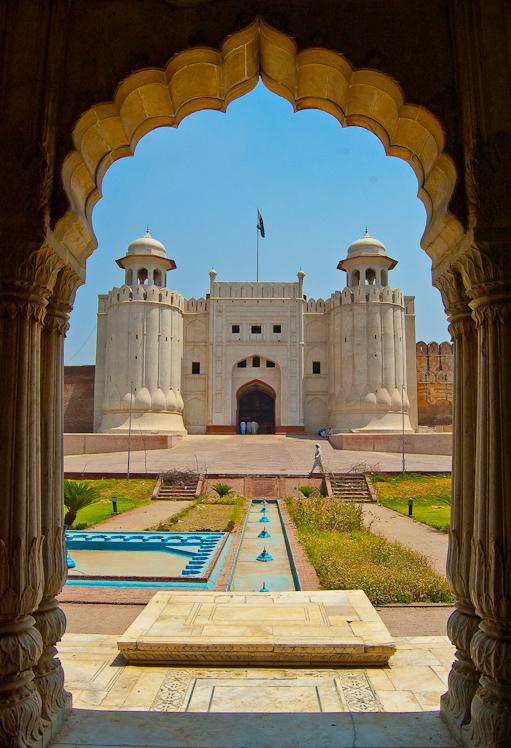
Lahore Fort. Photo: Wikimedia Commons.
Minar-e-Pakistan and Shalimar Gardens
East of the fort, in Iqbal Park, stands Minar-e-Pakistan, the tower marking the site of the Lahore Resolution of 1940. It is a natural stop after the fort and mosque, and the park around it is a popular evening walk. Further out, the Shalimar Gardens, laid out under Shah Jahan and inscribed by UNESCO with the fort in 1981, are a quieter Mughal garden of terraces, water channels and pavilions, best visited in the morning.
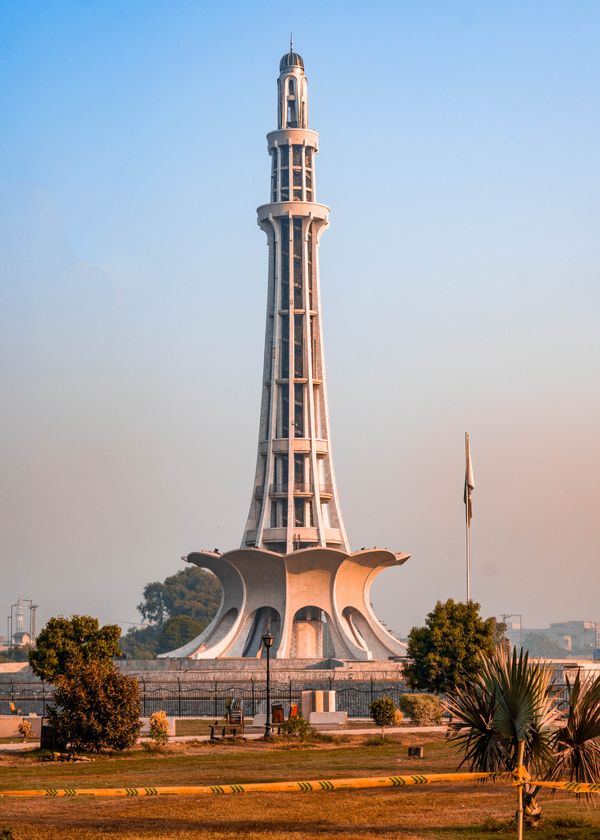
Minar-e-Pakistan, Lahore. Photo: Pexels.
Food: the other half of Lahore
Lahore is known for eating, and the food is half the reason to come. Breakfast is siri paye, halwa puri, or nihari with naan. At lunch and dinner look for karahi, chargha, tikka and river fish from the food shops of Gawalmandi. Lassi, kulfi and falooda are the standard cooling drinks and sweets. The best places to eat are Fort Road Food Street beside the Badshahi Mosque, opened by the Punjab government in January 2012, Gawalmandi, Anarkali Food Street, and the lanes around Mozang and Lakshmi Chowk. Eat a little at several places rather than a lot at one, and go where the locals queue.
A two-day plan
Day one: Start early at Delhi Gate and walk the Royal Road to the Wazir Khan Mosque, then on to the Lahore Fort and the Badshahi Mosque. Eat on Fort Road Food Street at midday, and spend the late afternoon at Minar-e-Pakistan and Iqbal Park.
Day two: Breakfast in Gawalmandi, then the Lahore Museum and the Shalimar Gardens, with the afternoon in Anarkali Bazaar and an evening meal on Food Street. If you have a third day, add the old city's lesser-known mosques and havelis, or a day trip out of the city.
When to go and practical tips
- Best months: October to March. February to early April is the most comfortable time. May to August is very hot, so do the outdoor sights at first light and eat late. Smog is common from October to January, so check air quality before planning long outdoor days.
- Getting around: The Orange Line Metro Train (27.1 kilometres, 26 stations, opened in October 2020) and the Metrobus cover some routes, but most visitors use ride-hailing apps and auto-rickshaws. The Walled City is best on foot.
- Dress and manners: Dress modestly, carry a scarf for mosques and shrines, and bring socks if the marble is hot underfoot. Remove your shoes at mosques, and keep quiet at prayer times.
- Basant: The spring kite festival was banned in Punjab from 2007 and returned in Lahore only on approved dates, so check the official dates before planning around it.
Plan your Lahore trip
Lahore is the best single place in Pakistan to see Mughal architecture, eat well and feel the pace of a big, old city, and it is where Travelia Planet is based. Pair a Lahore stay with a northern tour, such as Hunza or Skardu, or explore our other Pakistan guides on Travelia Planet.
Plan your trip with Travelia Planet
Visiting Lahore, or planning a tour from Lahore to the north? Message us on WhatsApp at +92 310 3996056, email contact@traveliaplanet.com, or visit traveliaplanet.com. Our office is at Allied Bank Building, Canal View Society, Lahore, Pakistan 54000. Open Monday to Saturday, 9 AM to 9 PM.
Comments
Post a Comment