
Naran & Kaghan Valley Guide: Lakes & Babusar Top
The Naran & Kaghan Valley is the classic first trip into northern Pakistan: a single road, the N-15, follows the Kunhar River from Balakot up through pine forest and alpine meadow to Naran, then climbs past two famous lakes to Babusar Top, the 4,173-metre pass that links the valley to the Karakoram Highway. In one valley you get a resort town, a legendary lake, quiet roadside water and a high pass with views in every direction. This guide covers the places, the road and the seasons, so you can plan the trip properly.
Where the valley runs
The Kaghan Valley runs north from Balakot in Mansehra District, Khyber Pakhtunkhwa, along the Kunhar River. The road climbs from the Hazara plains through forest, past the resort meadows of Shogran, to Naran at about 2,409 metres. Naran is the valley's hub: hotels, jeep stands, food stalls and the starting point for almost every excursion. From Naran the road continues north past Lulusar Lake to Babusar Top, then drops down to Chilas on the Karakoram Highway. The whole valley, from Balakot to the pass, runs roughly 155 kilometres.
Islamabad to Naran is about 245 to 280 kilometres by road, depending on the route, and most travellers do it in a day. The drive itself is part of the trip: the river stays beside the road for most of the way, and the scenery changes from farmland to forest to open alpine ground as you climb.
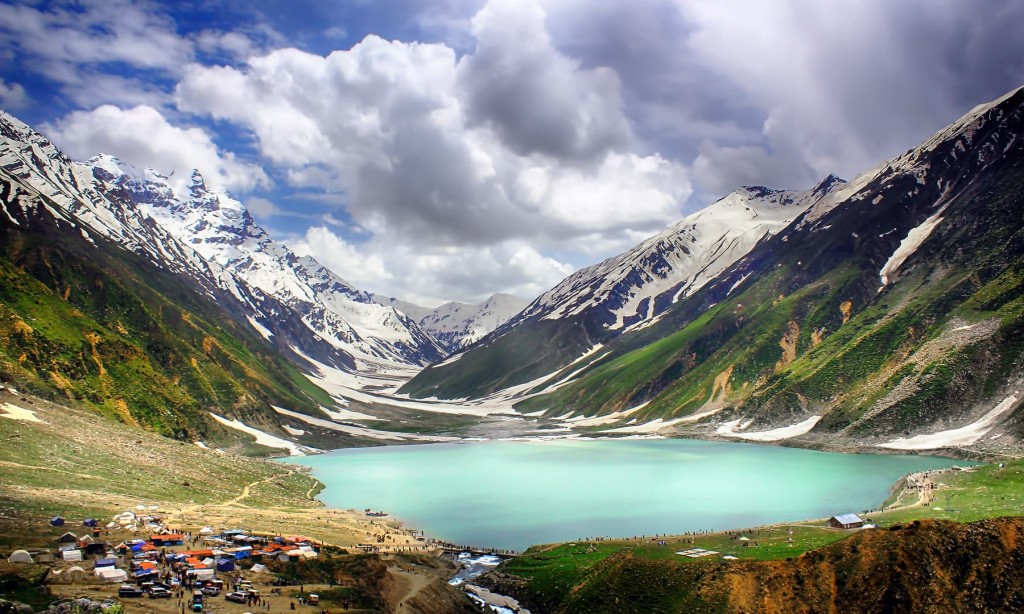
Lake Saiful Muluk below Malika Parbat. Photo: Wikimedia Commons.
Lake Saiful Muluk
Lake Saiful Muluk sits at about 3,224 metres, roughly 9 kilometres north of Naran, below Malika Parbat, the highest peak of the Kaghan Valley at about 5,291 metres. It is a glacial lake, oval in shape, ringed by snowfields in early summer, and it is the single most visited place in the valley. A rough jeep track climbs from Naran to the lake, and fit walkers can also hike up in a few hours.
The lake carries a famous story. The Sufi poet Mian Muhammad Bakhsh told the tale of Prince Saif-ul-Muluk, whose name means "Sword of Kings", and a fairy queen at this lake, and the legend is still told by guides and boatmen today. Go early in the morning for the calmest water and the clearest reflection of the peak. The lake sits above the tree line, so the wind is cold even on a warm day, and a jacket is worth carrying.
Shogran, Lalazar and the meadows
Below Naran, the valley's green side shows itself at Shogran, a hill resort at about 2,362 metres with views across to the Kaghan peaks. From Shogran a short jeep ride climbs to the Paye meadows, wide grassland with pine forest at its edges and Malika Parbat on the horizon. Lalazar, a pine-and-meadow plateau at about 3,123 metres above the valley, is another easy half-day trip from Naran, good for a slow walk rather than a climb.
These meadows are the valley at its gentlest, and they suit families and anyone who wants mountain air without a hard trek. The slopes are grazed in summer, wildflowers cover the grass after the snow melts, and the light in the late afternoon is the best of the day.

Paye meadows near Shogran. Photo: Wikimedia Commons.
Lulusar Lake
About 50 kilometres north of Naran, beside the road to Babusar, lies Lulusar Lake at about 3,410 metres. It is a long, quiet lake, and it is the source of the Kunhar River itself. Unlike Saiful Muluk it draws few crowds, which is exactly its appeal: a roadside stop where you can stand beside dark blue water with the high valley all around and hear almost nothing.
Lulusar is also a marker of altitude. From here the road steepens, the trees thin out, and the air gets noticeably thinner. Walk slowly, drink water, and do not rush the climb to the pass.

Lulusar Lake, source of the Kunhar River. Photo: Wikimedia Commons.
Babusar Top
Babusar Top, also called Babusar Pass, is the high point of the valley road at 4,173 metres (13,691 feet). It sits on the boundary between Khyber Pakhtunkhwa and Gilgit-Baltistan, and from the top you look back down the Kaghan Valley one way and across towards the Karakoram the other. On a clear day the sweep of peaks is the reward for the whole drive.
The pass is open only in summer, roughly from mid-June to the end of October, once the snow has been cleared. Even in July and August the daytime temperature at the top is only about 8 to 15 degrees Celsius, and it can be near freezing at night. Snow can sit beside the road into July. The climb from Naran is about 65 kilometres of steep road with sharp bends, so start early and drive in daylight.
Crossing Babusar brings you out at Chilas on the Karakoram Highway, which is why many travellers combine Kaghan with Hunza and Skardu on a longer northern loop. If you are planning the valley on its own, Naran makes a comfortable base for two or three nights. Our Swat & Kalam tour follows the same pattern of a road trip with a mountain base, in the neighbouring valley to the west.

The Babusar Top road at 4,173 metres. Photo: Wikimedia Commons.
When to go
The valley is a summer destination. The road to Naran is open for most of the year, but the high lakes and Babusar Top are summer-only. The best months are June to September, with July and August the warmest and greenest. May can still be cold at altitude, and by late October the pass usually closes with the first heavy snow. In peak summer Naran town is busy, especially on weekends, so midweek travel is quieter. Winter brings heavy snow, and most of the valley's tourist business shuts down.
Getting there and practical tips
- Route: Islamabad via the Hazara Expressway to Mansehra and Balakot, then the N-15 up the Kunhar Valley to Naran. Allow a full day for the drive.
- Jeeps: Lake Saiful Muluk and the high meadows are reached by local jeeps on rough tracks. Hire through your hotel or the jeep stand in Naran, and agree the route before you set off.
- Altitude: Naran is at 2,409 metres and the pass at 4,173 metres. Take it slowly on the first day, drink plenty of water, and watch for headaches or breathlessness.
- What to pack: Warm layers even in summer, a rain jacket, sun protection, sturdy shoes, and cash, as ATMs and mobile signals are unreliable in the upper valley.
- Walking: The hike from Naran to Saiful Muluk takes a few hours for fit walkers. Stronger hikers can continue from the upper valley to Dudipatsar and Ansoo lakes, which need a full day and a guide.
Plan your Naran & Kaghan trip
Naran and Kaghan reward travellers who take their time: a morning at the lake, an afternoon in the meadows, and a slow drive over the pass. Come in summer, start early, and let the altitude set the pace. For more northern Pakistan ideas, see our guides on Skardu and the rest of the north on Travelia Planet.
Plan your trip with Travelia Planet
Want help planning a Naran & Kaghan trip, or a longer northern Pakistan tour? Message us on WhatsApp at +92 310 3996056, email contact@traveliaplanet.com, or visit traveliaplanet.com. Our office is at Allied Bank Building, Canal View Society, Lahore, Pakistan 54000. Open Monday to Saturday, 9 AM to 9 PM.
Comments
Post a Comment