
Nepal: Kathmandu & Pokhara Travel Guide
This Nepal travel guide covers the two cities every first trip needs: Kathmandu, the ancient capital of the valley, and Pokhara, the lakeside town beneath the Annapurna range. Nepal is the closest foreign Himalaya to Pakistan, and one of the most welcoming — its temples, stupas and mountain views are unlike anything at home, yet the food, the crowds and the pace of life feel familiar. A week is enough for both cities, with a short trek or a day trip to Chitwan or Lumbini if you have more time.
Kathmandu: seven World Heritage Sites in one valley
Almost every Nepal trip starts in Kathmandu, and the valley earns its time. Within a roughly 30-kilometre radius sit seven UNESCO World Heritage Sites: the three Durbar Squares of Kathmandu, Patan and Bhaktapur, the stupas of Swayambhunath and Boudhanath, the Pashupatinath Temple and the Changu Narayan Temple. Give the city four or five days if you can; two or three if you must.
Kathmandu Durbar Square is the old royal heart of the city, a crowded square of temples, palaces and courtyards that survived the 2015 earthquake in part and is still being restored. Patan Durbar Square, across the Bagmati River, is quieter and more graceful, with the finest Newari architecture in the valley and a museum in the old palace. Bhaktapur, the third of the old cities, feels like a living museum: a pedestrian old town of brick and carved wood, famous for its pottery and its yoghurt, best visited early in the morning.

Boudhanath Stupa, Kathmandu — one of the largest stupas in the world. Photo: Wikimedia Commons.
Boudhanath and Swayambhunath
Boudhanath is one of the largest stupas in the world, a great white dome topped by the painted eyes of the Buddha, ringed by monasteries, butter-lamp shops and rooftop cafes. Walk the kora — the clockwise circuit — with the pilgrims, spin the prayer wheels, and climb to a rooftop at dusk, when the lamps are lit. It is the spiritual heart of Tibetan Buddhism in Nepal, and the most peaceful place in Kathmandu.
Swayambhunath, the Monkey Temple, sits on a hilltop west of the city, reached by a long flight of steps past the monkeys that give it its name. The view from the top — over the rooftops of Kathmandu to the hills beyond — is the best in the valley. Go at sunrise, when the air is clearest.
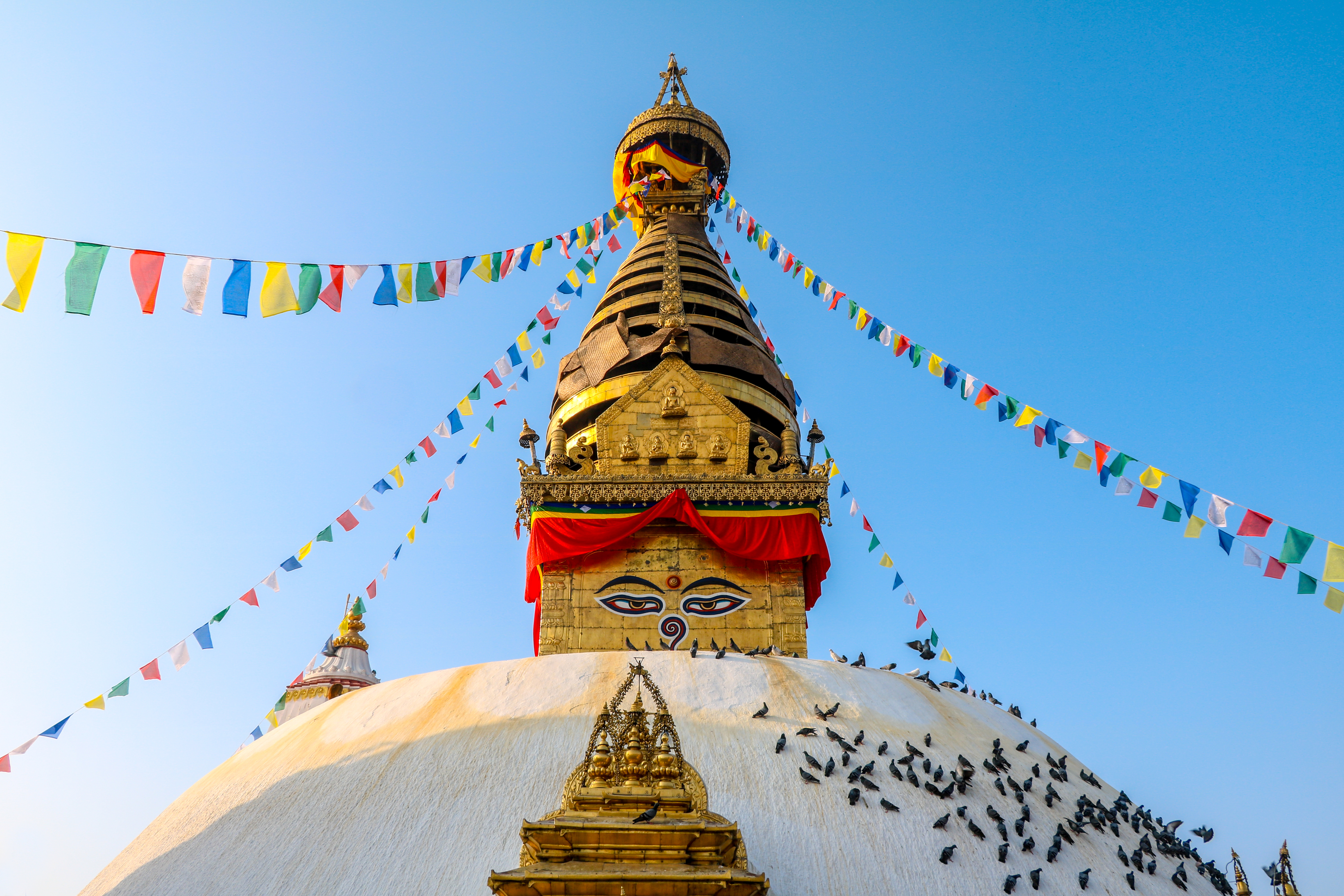
Swayambhunath, the Monkey Temple, above Kathmandu. Photo: Wikimedia Commons.
Pashupatinath and the old city
Pashupatinath, on the banks of the Bagmati River, is Nepal's most sacred Hindu temple, dedicated to Shiva. Non-Hindus cannot enter the main temple, but the ghats along the river — where cremations take place in the open, as they have for centuries — are visible from across the water. Visit with respect and a guide who can explain what you are seeing. Back in the old city, the lanes of Thamel and Asan are for shopping and eating: trekking gear, pashminas, thangka paintings, and momo dumplings at every corner. Try dal bhat, the lentil-and-rice staple, and the Newari dishes of the valley.

Patan Durbar Square, Kathmandu Valley. Photo: Wikimedia Commons.
Pokhara: the lake and the mountains
Pokhara, Nepal's second city, is the lakeside counterweight to Kathmandu — quieter, cleaner, and set on Phewa Lake with the Annapurna range filling the skyline. Most visitors stay in Lakeside, the strip of hotels, cafes and bookshops along the water — give it at least three days. Hire a boat on the lake at dawn, when the mountains reflect in the still water, and walk to the Tal Barahi Temple on its island. Climb to the World Peace Pagoda above the lake for the full panorama, and watch the sunset from Sarangkot, the hilltop where paragliders launch.

Phewa Lake, Pokhara, with the Annapurna range beyond. Photo: Wikimedia Commons.
Trekking from Pokhara
Pokhara is the gateway to the Annapurna region, the busiest trekking area in Nepal. You do not need to be a mountaineer: the classic short treks, like the walk to Ghorepani and Poon Hill, take four or five days and climb through rhododendron forest to a sunrise viewpoint over the Annapurnas and Dhaulagiri. Treks in the Annapurna region need conservation and trekking permits, easily arranged in Pokhara or Kathmandu. If trekking is not for you, Pokhara still offers zip-lining, bungee jumping and easy day walks to waterfalls and viewpoints.

Phewa Lake and the city of Pokhara. Photo: Wikimedia Commons.
When to go
Nepal's tourist year is built around two seasons either side of the monsoon. Autumn, from late September to early December, is the prime window: the monsoon rains have cleared the air, mountain visibility is at its best, temperatures are pleasant, and the festival calendar peaks with Dashain and Tihar through October and November. Late October and all of November are arguably the best weeks of all. Spring, from March to May, is the second window — rhododendron forests bloom at mid-elevation through April, making that the prettiest month for a mid-hills trek. Winter is cold but clear at altitude, and the monsoon, from June to mid-September, brings heavy rain and is the off-season for good reason.
Visas and practical tips
- Visa: Nepal is one of the more welcoming destinations for Pakistani travellers. A visa on arrival is available at Tribhuvan International Airport in Kathmandu, and SAARC nationals are eligible for a free 30-day tourist visa once per calendar year — but rules change, so check the current requirements before you travel, and message us on WhatsApp if you want help confirming them.
- Getting there: Fly into Tribhuvan International Airport, Kathmandu, usually with one connection from Pakistan. The domestic flight from Kathmandu to Pokhara takes about 25 minutes; tourist buses also run between the two cities.
- Altitude: Kathmandu sits at about 1,400 metres, Pokhara lower, so altitude is rarely a problem on a city trip — but if you trek, climb slowly and listen to your body.
- Money: The local currency is the Nepalese rupee. Carry cash in small notes for taxis, temples and markets, and keep US dollars in clean, undamaged notes for the visa counter if you need one.
- Getting around: Taxis and walking cover Kathmandu's old city; in Pokhara, Lakeside is walkable and boats and taxis cover the rest. Allow extra time everywhere — Kathmandu's traffic is slow, and its airport queues can be long.
- Combine it: Nepal's mountains pair naturally with a longer Himalayan journey, and our guides to the Khunjerab Pass and the Karakoram Highway and Astore Valley and Rama Meadows cover the same great range from the Pakistan side.
Plan your Nepal trip
Nepal gives you two trips in one: the temples and stupas of the Kathmandu Valley, and the lake and mountains of Pokhara, with a trek in between if you want it. Come in autumn for the clearest skies, and watch the sun rise over the Annapurnas from the shore of Phewa Lake. For more mountain ideas, see the rest of our guides on Travelia Planet and the Travelia Planet blog.
Plan your trip with Travelia Planet
Want help planning a Nepal trip? Message us on WhatsApp at +92 310 3996056, email contact@traveliaplanet.com, or visit traveliaplanet.com. Our office is at Allied Bank Building, Canal View Society, Lahore, Pakistan 54000. Open Monday to Saturday, 9 AM to 9 PM.
Comments
Post a Comment