
Vietnam: Hanoi & Ha Long Bay Travel Guide
This Vietnam travel guide covers the north of the country, the part every first trip should see. Hanoi, the thousand-year-old capital, and Ha Long Bay, its great natural wonder, are only a few hours apart, and together with the river valleys of Ninh Binh they make a complete journey in a week. Vietnam runs north to south for more than 1,600 kilometres, and the north is its most atmospheric corner: misty mornings, old streets and limestone karsts.
Hanoi: the Old Quarter and Hoan Kiem Lake
Hanoi's Old Quarter is a tight grid of narrow streets just north of Hoan Kiem Lake, each once named for the goods sold on it — silk, paper, tin, herbs. The quarter is best explored on foot, with stops for coffee and pho: a bowl of noodle soup on a low plastic stool is the Hanoi breakfast, and the best versions are in the smallest shops. The streets are chaotic — motorbikes, vendors, and shops spilling onto the pavement — but that chaos is the charm. Cross the road slowly and steadily, and the traffic flows around you.
Hoan Kiem Lake, the Lake of the Returned Sword, is the calm centre of the city. Walk the loop in the early morning, when locals exercise along the shore, and cross the red Huc Bridge to the Ngoc Son Temple on its island. At dusk the lake lights up, and the weekend streets around it close to traffic and fill with families and musicians. Nearby, the Temple of Literature — Vietnam's first university — is a quiet garden of courtyards and stone stelae.

A market street in Hanoi's Old Quarter. Photo: Wikimedia Commons.
Ha Long Bay: a night on the water
Nearly two thousand limestone islands rise straight out of the Gulf of Tonkin at Ha Long Bay, a UNESCO World Heritage Site, and the only way to see them properly is to stay the night on a boat. Most cruises leave the harbour at midday, anchor among the islands for sunset, and stop for kayaking, a cave and a floating village before returning the next morning. One night is enough for most travellers; two lets you reach the quieter bays. In winter the mist sits low over the water at dawn — cold on deck, but beautiful. The bay is about two and a half hours by road from Hanoi, and most cruises include the transfer.
If you want the same scenery with fewer boats, look at Lan Ha Bay, next door to Ha Long, or Bai Tu Long Bay to the east — both are quieter. Whatever you choose, book a reputable operator and check what is included before you pay: the difference between a good cruise and a poor one is large.

The limestone islands of Ha Long Bay. Photo: Wikimedia Commons.
Ninh Binh: Ha Long Bay on land
Two hours south of Hanoi by road, Ninh Binh is the landscape people call Ha Long Bay on land — limestone cliffs, winding rivers and rice fields, without the sea. The Trang An Landscape Complex, a UNESCO site, is best seen by boat: a slow row through caves and valleys, past temples hidden in the cliffs. Tam Coc, the nearby hub, offers the same boat rides through three caves, and the climb to Mua Cave rewards you with the whole valley below. Ninh Binh is quieter and slower than Ha Long Bay — give it two days, and cycle between the sights in the early morning.

Hoan Kiem Lake in the heart of Hanoi. Photo: Wikimedia Commons.
Food: eating your way through the north
Northern Vietnamese food is lighter and more herbal than the south, and Hanoi is the place to learn it. Pho, the beef noodle soup, was born here; bun cha — grilled pork with noodles and herbs — is the city's other signature dish, eaten at lunchtime in busy little restaurants. Try egg coffee, a Hanoi invention of whipped egg yolk over strong coffee, and banh mi, the stuffed baguette that is Vietnam's great street sandwich. Eat where the locals eat, and order what everyone else is having. Halal restaurants are available in Hanoi and Ho Chi Minh City — ask us on WhatsApp for the current options.

Boating through the Trang An Landscape Complex, Ninh Binh. Photo: Wikimedia Commons.
Beyond the north: Hue, Hoi An and the centre
If you have more time, keep going south. A short flight from Hanoi reaches Hue, the old imperial city, with its citadel, royal tombs and the Perfume River — and from there the coast road runs to Da Nang and Hoi An, the lantern town of the central coast, where the old town glows at night. Two weeks covers the north and centre comfortably: Hanoi, a night on Ha Long Bay, the river valleys of Ninh Binh, then a flight to Hue and a few slow days in Hoi An. The far south — Ho Chi Minh City and the Mekong Delta — is another trip, worth its own week.
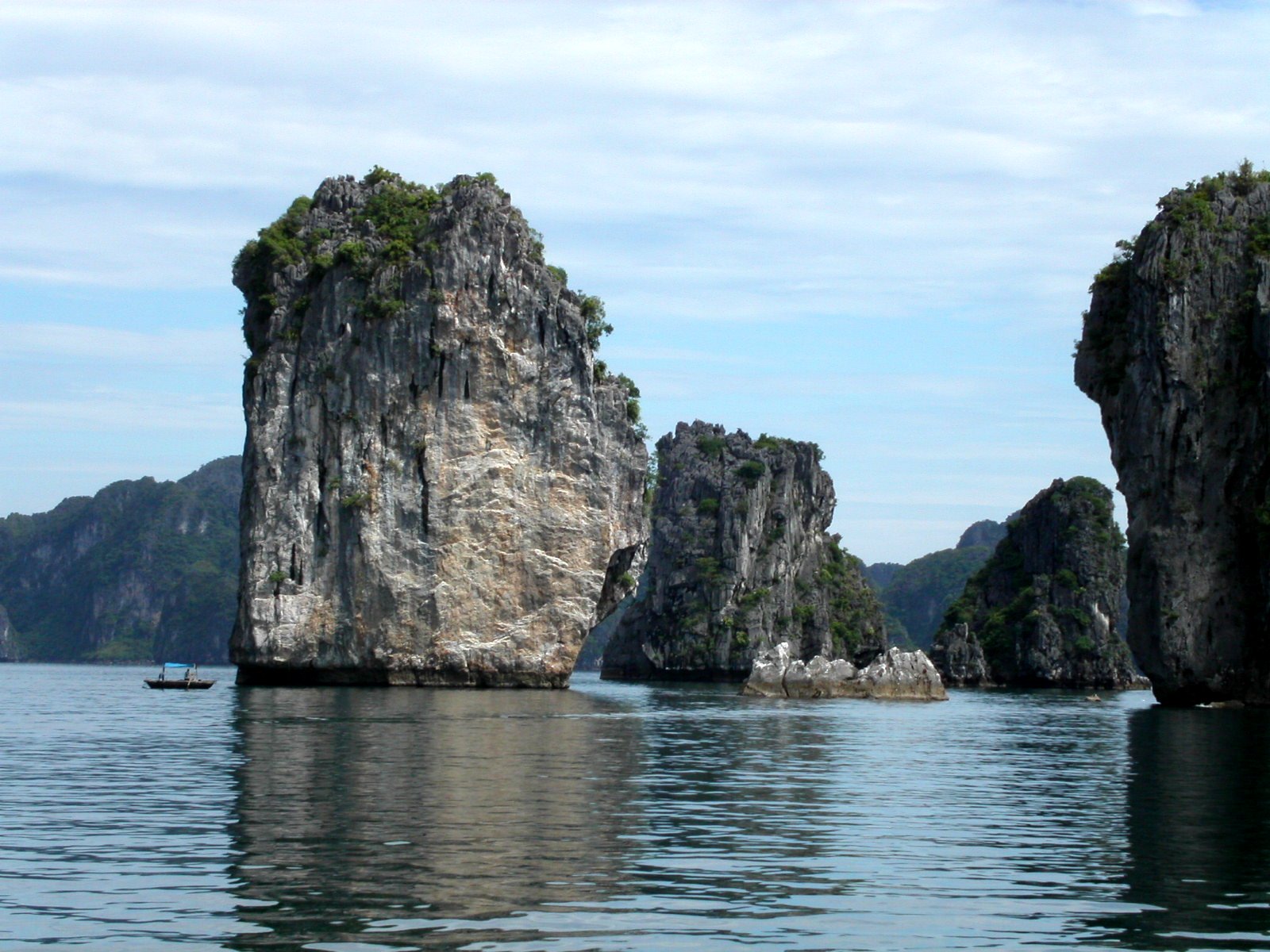
Karsts rising from the water at Ha Long Bay. Photo: Wikimedia Commons.
When to go
The best time to visit the north is spring or autumn: March to April brings sunshine, and November brings blue-sky days and fewer crowds. Ha Long Bay attracts visitors year-round, with the peak season from October to April. January to March is often cool and drizzly, and the fog can make visibility low — but it adds atmosphere to the bay. From May to September, tropical storms are frequent, and boats sometimes need to change their routes. Plan around Tet, the lunar new year — on 6 February 2027 — when for about a week either side, shops close and transport sells out, so book everything well ahead.
Visas and practical tips
- Visa: Vietnam offers e-visas to citizens of every country, Pakistan included, through its official portal — but rules change, so check the current requirements before you travel. Message us on WhatsApp and we will guide you.
- Getting there: There are no direct flights from Pakistan to Vietnam, so plan a connection through a Middle East or Southeast Asian hub, usually nine to fourteen hours in total. An open-jaw ticket — landing in Hanoi and departing from Ho Chi Minh City, or the reverse — is the smartest way to see the country.
- Getting around: Domestic flights connect Hanoi with Hue, Da Nang and Ho Chi Minh City. In the cities, ride-hailing apps work well.
- Money: The local currency is the Vietnamese dong. Cash is king at street stalls, and ATMs are easy to find in the cities.
- Staying connected: A local SIM needs your passport and a face scan at the counter, so an eSIM is the quicker option.
- Combine it: Vietnam pairs naturally with the rest of Southeast Asia, and our guides to Thailand and Singapore cover the region's other great first trips.
Plan your Vietnam trip
Vietnam's north gives you everything in one week: a thousand-year-old capital, a night among the karsts of Ha Long Bay, and the river valleys of Ninh Binh — with street food at every step. Come in spring or autumn, book the cruise properly, and leave room for the unexpected: a bowl of pho at dawn, a misty morning on the bay. For more ideas, see the rest of our international guides on Travelia Planet and the Travelia Planet blog.
Plan your trip with Travelia Planet
Want help planning a Vietnam trip? Message us on WhatsApp at +92 310 3996056, email contact@traveliaplanet.com, or visit traveliaplanet.com. Our office is at Allied Bank Building, Canal View Society, Lahore, Pakistan 54000. Open Monday to Saturday, 9 AM to 9 PM.
Comments
Post a Comment