
Faisalabad Travel Guide: Clock Tower & Food
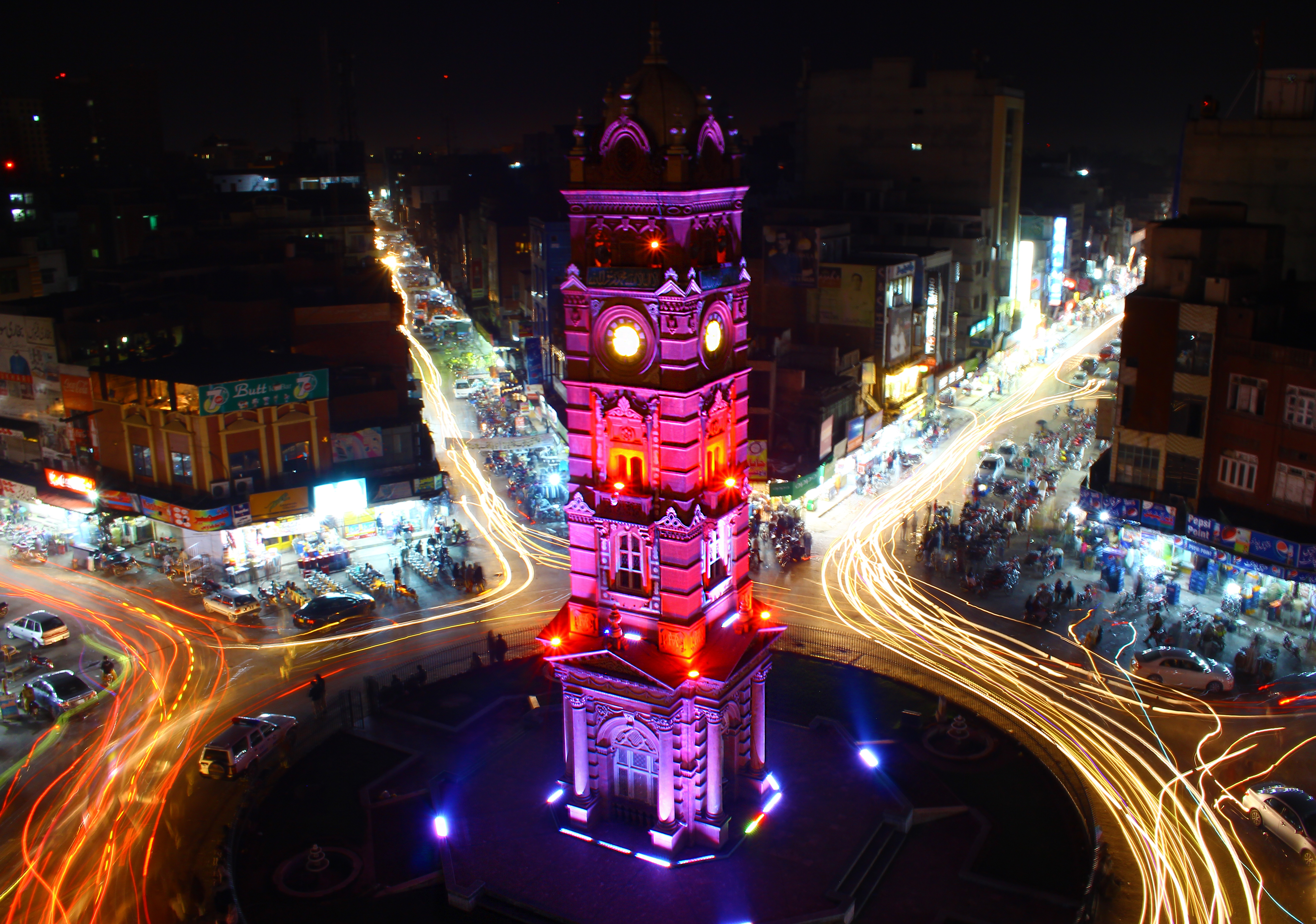
This Faisalabad travel guide starts where the city itself starts: at the red sandstone Clock Tower, or Ghanta Ghar, in the middle of eight bazaars that fan out like the Union Jack. Faisalabad is Punjab's great working city — Pakistan's textile capital, a canal-colony town drawn on paper before a single brick was laid, and a place where the food is as serious as the trade. Its pleasures are a morning in the bazaars, a slow breakfast of halwa puri and lassi, and the sight of a clock tower that has watched over it all for more than a century.
A city drawn on paper: Lyallpur
Faisalabad barely existed before the British arrived. The land here was Sandal Bar, dry scrub country between the Chenab and Ravi rivers, until canal water from the Lower Chenab turned it into some of the most productive farmland in South Asia. The new town was planned as the headquarters of the canal colony, laid out as an agricultural market town, and named Lyallpur after Sir James Lyall, the lieutenant governor of the Punjab. The city plan was drawn by the architect Sir Ganga Ram, and its most famous feature was the street pattern: eight roads radiating from a central point, linked by a circular road, so that from above the layout resembles the Union Jack flag. The town became a municipality in 1898, and in 1979 it was renamed Faisalabad in honour of King Faisal of Saudi Arabia. Today it is one of Pakistan's largest cities and the centre of the country's textile industry.
The Clock Tower, or Ghanta Ghar, in the heart of Faisalabad. Photo: Wikimedia Commons.
Ghanta Ghar: the Clock Tower of 1905
The Clock Tower is the most recognised building in Faisalabad and one of the city's oldest monuments still standing in its original state. The site was chosen by Sir James Lyall himself, and the foundation stone was laid on 14 November 1905 by the lieutenant governor of Punjab, Sir Charles Montgomery Rivaz. The tower is built of red sandstone brought from Sangla Hill, about 50 kilometres away, in the Indo-Saracenic Revival style that blends European and South Asian forms. Money for the building was raised at a rate of Rs. 18 per square of land and handed to the Municipal Committee, which completed the work in two years at a cost of Rs. 40,000. The inscription at its base records that it was raised in memory of Queen Victoria by the loyal inhabitants of the Chenab Colony.
Stand at the tower and you stand at the centre of the old city. Four main roads — Circular Road, Kotwali Road, Regal Road and Sargodha Road — mark the edges of the square around it, and from the tower the eight bazaars run out in every direction.
The eight bazaars
The eight bazaars are the real Faisalabad. Each is named for the direction it leads towards, and each has its own trade, built up over more than a century. Katchery Bazaar is known for mobile phones, Chiniot Bazaar for medicine and cloth, Aminpur Bazaar for stationery and home decor, Bhawana Bazaar for electrical goods, Jhang Bazaar for fish, meat, fruit and vegetables, Montgomery Bazaar — also called Sutar Mandi — for yarn and raw cloth, Karkhana Bazaar for herbal medicines, and Rail Bazaar for gold and cloth. A round bazaar, Gole Bazaar, links them all together. Montgomery Bazaar, with its bales of yarn and bolts of raw fabric, is the most evocative for a visitor — the textile trade made visible, lane after lane of it.

Ghanta Ghar, the Clock Tower of Faisalabad, built of red sandstone in 1905. Photo: Wikimedia Commons.
Textiles: the city that weaves
Faisalabad's identity is cloth. The city grew up around cotton, and today its mills, power looms and wholesale yarn markets make it Pakistan's textile capital. You cannot tour a mill as a casual visitor, but you can see the trade in the bazaars and feel it in the city's energy — the trucks loaded with fabric, the dye houses on the outskirts, the shops selling everything from raw cotton to finished lawn and khaddar. For shoppers, the reward is fabric at wholesale prices, sold by the yard in the cloth bazaars around the Clock Tower. The University of Agriculture, founded as the Punjab Agricultural College in 1906 and raised to university status in 1961, has one of the oldest campuses in the country and shaped the farming of the whole Punjab plain.
Lyallpur Museum and Jinnah Garden
For the city's story in one place, visit the Lyallpur Museum, near the Allama Iqbal Library, which opened in 2011. Its galleries trace the district from ancient times through the canal colony era to the industrial city. It is the best single stop for making sense of what you have seen in the bazaars. Afterwards, Jinnah Garden — the city's old Company Bagh — offers the green counterpoint: lawns, old trees and families out for the evening, a good place to sit and recover from the bazaars with a cup of tea. The garden is at its best in the late afternoon, when the heat eases and the city comes out to walk.

Aminpur Bazaar, one of the eight bazaars around the Clock Tower. Photo: Wikimedia Commons.
Eating in Faisalabad
Faisalabad eats well, and it eats early. Breakfast is the city's great meal: halwa puri, cholay and lassi in the old-city eateries near the Clock Tower, served from the early morning to crowds of workers and traders. By lunchtime the barbecue stalls and karahi houses take over, and in the evening the food streets fill with families out for tikka, kebab, gola ganda and chaat. The D Ground area, in the newer part of the city, is the modern face of Faisalabad's food scene, with restaurants and cafes that stay busy late. As in any Punjabi city, the best rule is to follow the crowds: a busy stall with a long queue is almost always the right choice.
When to go and how to get there
Faisalabad is about 130 kilometres from Lahore, roughly two hours by the M-3 motorway, which makes it an easy day trip from the provincial capital — and a natural stop on a wider Punjab tour that also takes in Lahore and Multan. The best months are October to March, when the Punjab plain is cool and the bazaars are comfortable to walk. Summer is hot, as it is across the plains, so plan early mornings and late afternoons if you come between May and August. For getting around, rickshaws and ride-hailing cover the city; for the old town, walk — the eight bazaars are best explored on foot.

The Clock Tower and the bazaars around it, seen from above. Photo: Wikimedia Commons.
Plan your Faisalabad trip
Faisalabad rewards the traveller who likes markets, food and the feeling of a city at work. Come for the Clock Tower and its eight bazaars, stay for the fabric, the museum and the breakfasts, and leave with a sense of the Punjab that the postcards miss.

The University of Agriculture, Faisalabad, founded in 1906. Photo: Wikimedia Commons.
Plan your trip with Travelia Planet
Want help planning a Faisalabad trip? Message us on WhatsApp at +92 310 3996056, email contact@traveliaplanet.com, or visit traveliaplanet.com. Our office is at Allied Bank Building, Canal View Society, Lahore, Pakistan 54000. Open Monday to Saturday, 9 AM to 9 PM.
Comments
Post a Comment