
Mohenjo-daro: The Ancient Indus City
This Mohenjo-daro guide takes you to one of the oldest cities on earth: a planned city of baked brick on the banks of the Indus, built around 2500 BCE, when the pyramids of Egypt were still new. Mohenjo-daro was one of the largest cities of the Indus Valley Civilisation, and it was the first site in South Asia to be inscribed on UNESCO's World Heritage List, in 1980. Walking its grid of streets today, past the Great Bath and the Great Granary, you are walking through a city that had covered drains and public baths four and a half thousand years ago.
A city built on a grid
Mohenjo-daro stands on the right bank of the Indus River in Larkana District, Sindh, about 28 kilometres from the town of Larkana. Its modern name means "Mound of the Dead Men" in Sindhi; the city's original name is unknown. It was built in the 26th century BCE, and at its height it held at least 40,000 people, contemporary with the civilisations of Egypt and Mesopotamia.
The city was planned from the start. It falls into two parts: a raised western mound, the Citadel, about 12 metres high, where the great public buildings stood, and a larger Lower Town to the east, laid out in rectangular blocks on a grid of straight streets. The houses were built of baked brick, and many had wells, bathrooms and toilets connected to covered drains along the streets — urban engineering not seen again in South Asia for thousands of years. The city flourished for centuries, then declined, and by around 1900 BCE it had been abandoned. Its ruins lay undocumented for some 3,700 years.
Rediscovery in the 1920s
Mohenjo-daro was rediscovered in 1922, when R. D. Banerji of the Archaeological Survey of India recognised the mound for what it was. Under Sir John Marshall, the Survey made it the centre of its work: trial trenches in 1923 to 1925, then a great campaign in the winter of 1925 to 1926, with between 1,000 and 1,200 labourers. It was Marshall himself who uncovered the Great Bath, and Ernest Mackay took over the digging from 1926 to 1927. The finds — the seals, the bronze Dancing Girl, the steatite Priest-King — announced a civilisation nobody had known existed.
UNESCO ran one of its largest safeguarding campaigns here, "Save Mohenjodaro", from 1974 to 1997, and inscribed the site on the World Heritage List in 1980. The site is still threatened today, by erosion, salt damage and flooding — heavy rains in 2022 damaged parts of the ruins — and much of the city has never been excavated at all.

The stupa mound rising above the ruins of Mohenjo-daro. Photo: Wikimedia Commons.
The Great Bath
The best-known building in Mohenjo-daro stands on the Citadel: the Great Bath, a sunken brick pool about 12 metres long, 7 metres wide and 2.4 metres deep, made watertight with bitumen and fed by a well in an adjoining room. It is the earliest public water tank in the ancient world. Most scholars think it was used for ritual bathing, a place of purification, and it sits in a courtyard surrounded by rooms that may have belonged to priests. Standing at its edge, looking down at the brickwork that has held water for four millennia, is the single most memorable moment of a visit.
Around the Great Bath stand the other buildings of the Citadel: the Great Granary, a brick foundation about 50 by 27 metres that once stored the city's grain; and the College Square, a large pillared hall that may have been a place of assembly. Together they show a city that was organised, wealthy and governed — even if we still do not know by whom.
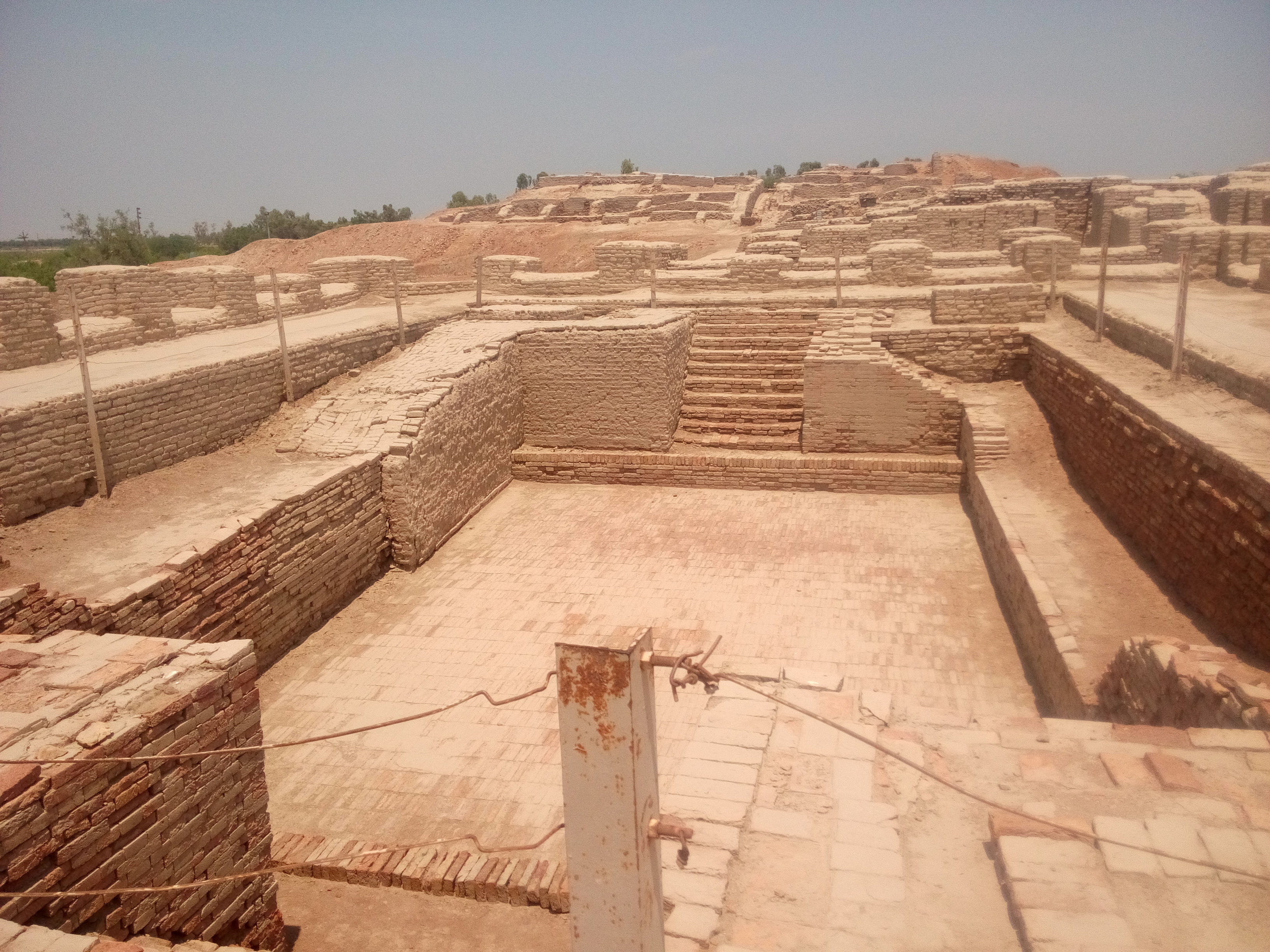
The Great Bath, the earliest public water tank in the ancient world. Photo: Wikimedia Commons.
The Lower Town and the museum
East of the Citadel, the Lower Town is where most people lived, and it shows the city's planning best: straight streets crossing at right angles, blocks of houses with courtyards, and drains beneath the streets. Walk the main street slowly and you can read the city in the brickwork — the uniform bricks, the doorways, the wells. The site covers 240 hectares, and it takes a couple of hours to walk properly.
On the highest mound of the Citadel stands a later layer of history: a Buddhist stupa and monastery, built in the 2nd century CE, some two thousand years after the city was abandoned.
Before or after the ruins, visit the site museum, which holds the finds from the excavations: seals carved with animals and a script nobody has yet deciphered, pottery, beads, tools, and models that explain how the city was built. The most famous objects — the Dancing Girl and the Priest-King — are held in museums elsewhere, but the site museum gives the best sense of the city itself.

The Buddhist stupa on the Citadel mound, built 2,000 years after the city. Photo: Wikimedia Commons.
The treasures of the Indus
What makes Mohenjo-daro extraordinary is not only its age but its modernity. The Indus civilisation, at its widest, covered more than a million square kilometres between the Arabian Sea and the Himalaya, and more than a thousand of its settlements are known — yet only five were true cities: Mohenjo-daro, Harappa, Ganeriwala, Dholavira and Rakhigarhi. Its people traded in lapis lazuli, carnelian and shell, made fine jewellery and pottery, and wrote a script of hundreds of signs that scholars still cannot read. The seals they pressed into clay — a unicorn, a bull, a figure seated among animals — are among the most beautiful objects of the ancient world.

The Dancing Girl, the famous bronze figure found at Mohenjo-daro. Photo: Wikimedia Commons.
When to go
The best months to visit Mohenjo-daro are November to February, when Sindh is cool and the light is soft over the brickwork. Summer in Larkana is very hot, and the site has almost no shade, so avoid the middle of the day between May and August. The ruins are best seen in the early morning or late afternoon. Allow a full day from Larkana, including the museum.
Getting there and practical tips
- Route: Mohenjo-daro is about 28 kilometres south of Larkana, reached by road from the town. Larkana is connected by road and rail to the rest of Sindh.
- Getting around: The site is walked on foot. Wear a hat and sturdy shoes, carry water, and take a guide at the entrance — the ruins are hard to read without one.
- Respect the site: Do not climb on the walls or walk on the brickwork. The structures are fragile, and erosion and salt are already eating at them.
- Combine it: Mohenjo-daro pairs naturally with Thatta & Makli, Sindh's other great UNESCO site, or with the Thar Desert & Nagarparkar for a longer Sindh journey.
Plan your Mohenjo-daro trip
Mohenjo-daro is not a place of palaces or tombs — it is a place of streets, drains and bricks, and that is what makes it so powerful. This was a city of ordinary people who built extraordinarily well. Go in winter, go slowly, and go with a guide. For more ideas, see the rest of Pakistan on Travelia Planet and our guide to Taxila, another of Pakistan's great ancient cities.

The ruins of Mohenjo-daro. Photo: Wikimedia Commons.
Plan your trip with Travelia Planet
Want help planning a Mohenjo-daro trip? Message us on WhatsApp at +92 310 3996056, email contact@traveliaplanet.com, or visit traveliaplanet.com. Our office is at Allied Bank Building, Canal View Society, Lahore, Pakistan 54000. Open Monday to Saturday, 9 AM to 9 PM.
Comments
Post a Comment