
Thar Desert & Nagarparkar: Karoonjhar Hills
The Thar Desert is Sindh's other world: rolling sand ridges, thorny scrub and villages of round thatched huts called chaunras, where peafowl strut between the courtyards and camels graze the dunes. At its far south-eastern edge, near the border with Rajasthan and the salt flats of the Rann of Kutch, the sand gives way to rock. The pink granite domes of the Karoonjhar Hills rise above the small town of Nagarparkar, where medieval Jain temples stand among the hills. This guide covers the road, the desert town of Mithi, and the temples and hills of Nagarparkar.
The road: Karachi to Mithi to Nagarparkar
The journey starts in Karachi and runs east through Hyderabad, then across the desert to Mithi, the capital of Tharparkar district, about 342 kilometres and roughly four hours and forty minutes of driving. Hyderabad, about 161 kilometres from Karachi on the M-9 motorway, is the usual fuel and meal stop. From Mithi the road continues east to Nagarparkar, about 129 to 132 kilometres further, roughly two hours more, making the full drive from Karachi about 473 kilometres, around six hours and forty minutes.
This is a long drive on district roads rather than motorways: a full tank at Mithi, drinking water, cash in small notes, and daylight for the last stretch. There is no scheduled tourist transport to Nagarparkar, so most visitors travel by hired car or van from Mithi or Umerkot. Carry your national identity card, as there are checkpoints on the route.
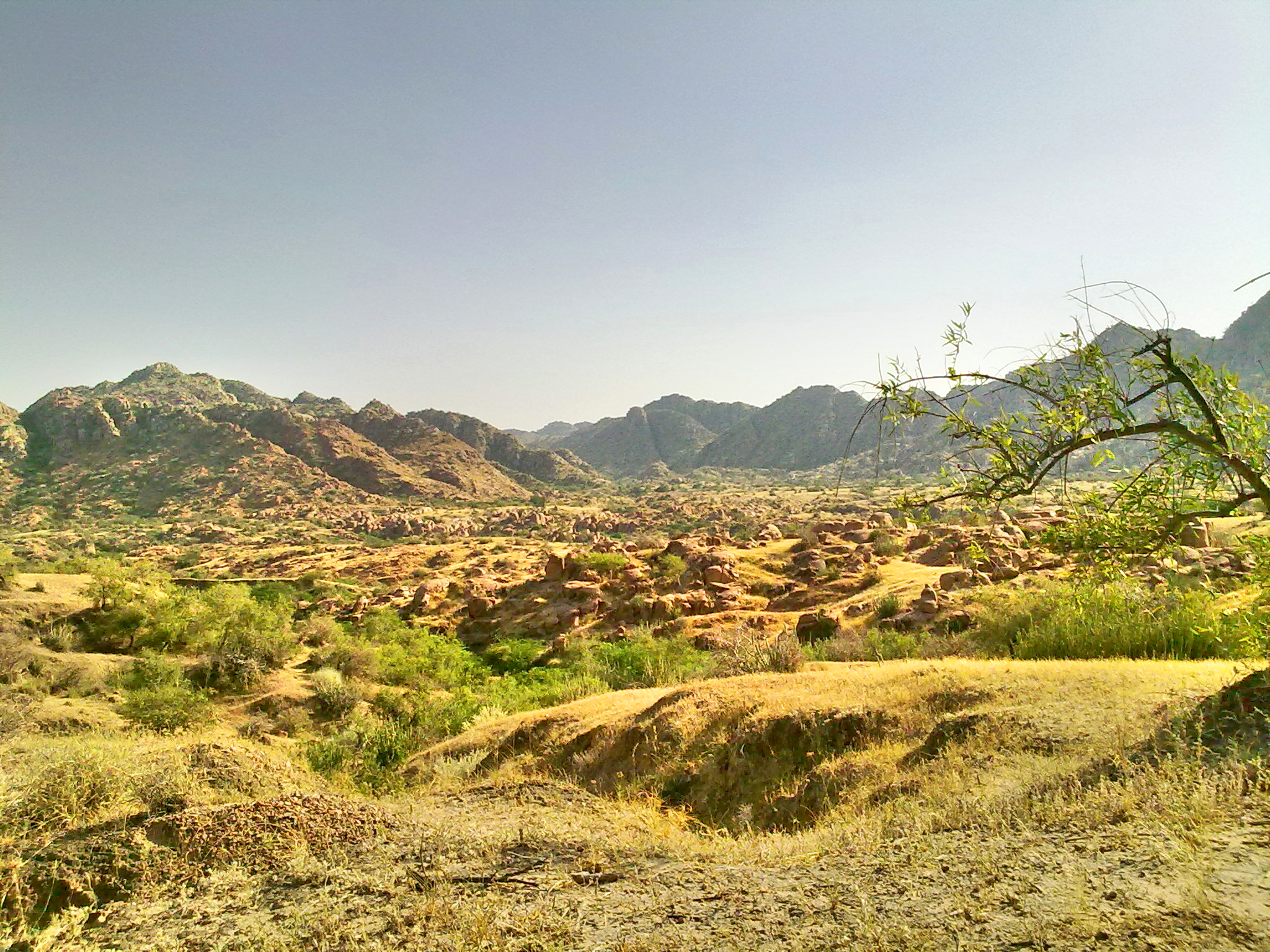
The Karoonjhar Hills above Nagarparkar. Photo: Wikimedia Commons.
Mithi: the desert capital
Mithi is the base for the whole region, and a town unlike any other in Pakistan. About 70 per cent of the people of Mithi taluka are Hindu, according to the 2023 census, and the town is known for its tradition of interfaith harmony, with mosques and temples standing side by side. The main local language is Dhatki, close to Marwari across the border, and the town has hotels, food, fuel and mud-brick architecture.
Spend a night in Mithi if you can: the evening light on the sand, the sound of peafowl at dawn, and a town that runs at desert pace. Mithi is also the base for the Thar Coal project, so the roads carry heavy industrial traffic as well as visitors. From here, Nagarparkar is a day trip, but an early start is essential.
Nagarparkar and the Karoonjhar Hills
Nagarparkar sits at the foot of the Karoonjhar Hills, the easternmost part of Sindh, near the Rann of Kutch. The hills are the only high ground for hundreds of kilometres: rounded domes of pink granite stretching about sixteen miles across the south of the area, with pools and old pilgrimage sites in their folds. Climb in the early morning for the views and the cooler air. The hills are also the setting of the legend of Marvi, the heroine of Shah Abdul Latif Bhittai's poetry, who refused a king's palace for her desert village; the village of Bhalwa nearby is remembered as her home.
The hills turn green after the monsoon rains, usually from July to September, when the desert blooms and the tanks fill, though dirt tracks can be hard to use after heavy rain, so check conditions first.

Nagarparkar seen from the Karoonjhar Hills. Photo: Wikimedia Commons.
The Jain temples of Nagarparkar
The real treasure of Nagarparkar is its Jain temples. Jain merchants grew rich here on trade when, as late as the 15th century, the sea reached close to these hills, and between the 12th and 15th centuries they built temples at Gori, Bhodesar and Virawah and in the town itself. About fourteen Jain temples survive, most in the Svetambara tradition, and in 2016 Pakistan placed the Nagarparkar Cultural Landscape on UNESCO's Tentative List.
The Gori Temple, built in 1375 to 1376, is the largest and best known: white marble on a raised platform reached by carved stone steps, about 125 by 60 feet, ringed by 52 small shrines, with painted frescoes described by UNESCO as the oldest frescoes of any Jain temple in North India. At Bhodesar, about four miles from the town, stand three ruined temples beside a tank, and next to them the white marble Bhodesar Mosque, built in 1505 under Sultan Mahmud Begada of Gujarat. The Virawah temples, near the ruins of the old seaport of Parinagar, are traditionally said to have been founded in 456 CE.
The temples stand empty but remarkably intact, cared for by local people of several faiths, and some are still used by the Hindu community. They are protected under the Antiquities Act. Walk them quietly, as you would a graveyard, dress modestly, and ask before photographing people. Keep out of damaged structures: the oldest Bhodesar temple is unstable.

The Gori Jain Temple near Nagarparkar. Photo: Wikimedia Commons.
Desert culture: villages, festivals and the Rann
Thar is not just temples and hills; it is a living culture. The villages between Mithi and Nagarparkar are built of mud and thatch, and their people keep crafts, music and food traditions that belong to the desert. Donkey carts are still common on the tracks, and peafowl wander between the courtyards.
The Churrio Jabal hill carries the Durga Mata temple, and its Shivratri festival draws very large crowds, so plan your dates around it if you want to avoid the rush. To the south lie the salt flats of the Rann of Kutch, a white expanse that feels like the edge of the world. November to February brings cool days and cold nights; the heat from April to September is severe.

The road to Nagarparkar through the desert. Photo: Wikimedia Commons.
When to go and practical tips
The most comfortable months are November to February. August and September, just after the monsoon, are the other good window, when the desert turns green. Avoid the hottest months unless you are used to desert heat, and remember that the monsoon can make the dirt tracks difficult.
- Route: Karachi via the M-9 to Hyderabad, then to Mithi and Nagarparkar. Allow a full day for the drive each way.
- Stay: Mithi has the best hotels; Nagarparkar has basic rest houses and simple restaurants. Book ahead in the busy season.
- Pack: Water, snacks, sun protection, warm layers for cold desert nights, cash, and your identity card.
- Respect: Ask before photographing people and dress modestly; many sites are sacred to local families.
For more of Sindh's heritage, see more guides on the Travelia Planet blog, and our Lahore travel guide for another side of Pakistan's history. More journeys are on Travelia Planet.

A donkey cart in Tharparkar District. Photo: Wikimedia Commons.
Plan your Thar & Nagarparkar trip
Thar rewards travellers who take it slowly: a night in Mithi, a morning in the Karoonjhar Hills, and an afternoon among temples that have stood for six centuries. Come in winter, travel in daylight, and bring respect for the people you meet.
Plan your trip with Travelia Planet
Want help planning a Thar Desert trip? Message us on WhatsApp at +92 310 3996056, email contact@traveliaplanet.com, or visit traveliaplanet.com. Our office is at Allied Bank Building, Canal View Society, Lahore, Pakistan 54000. Open Monday to Saturday, 9 AM to 9 PM.
Comments
Post a Comment